Why “Pretty Websites” Are Quietly Killing Local Businesses (And The Strategist’s Cure)
Website Strategy & Local SEO
Introduction
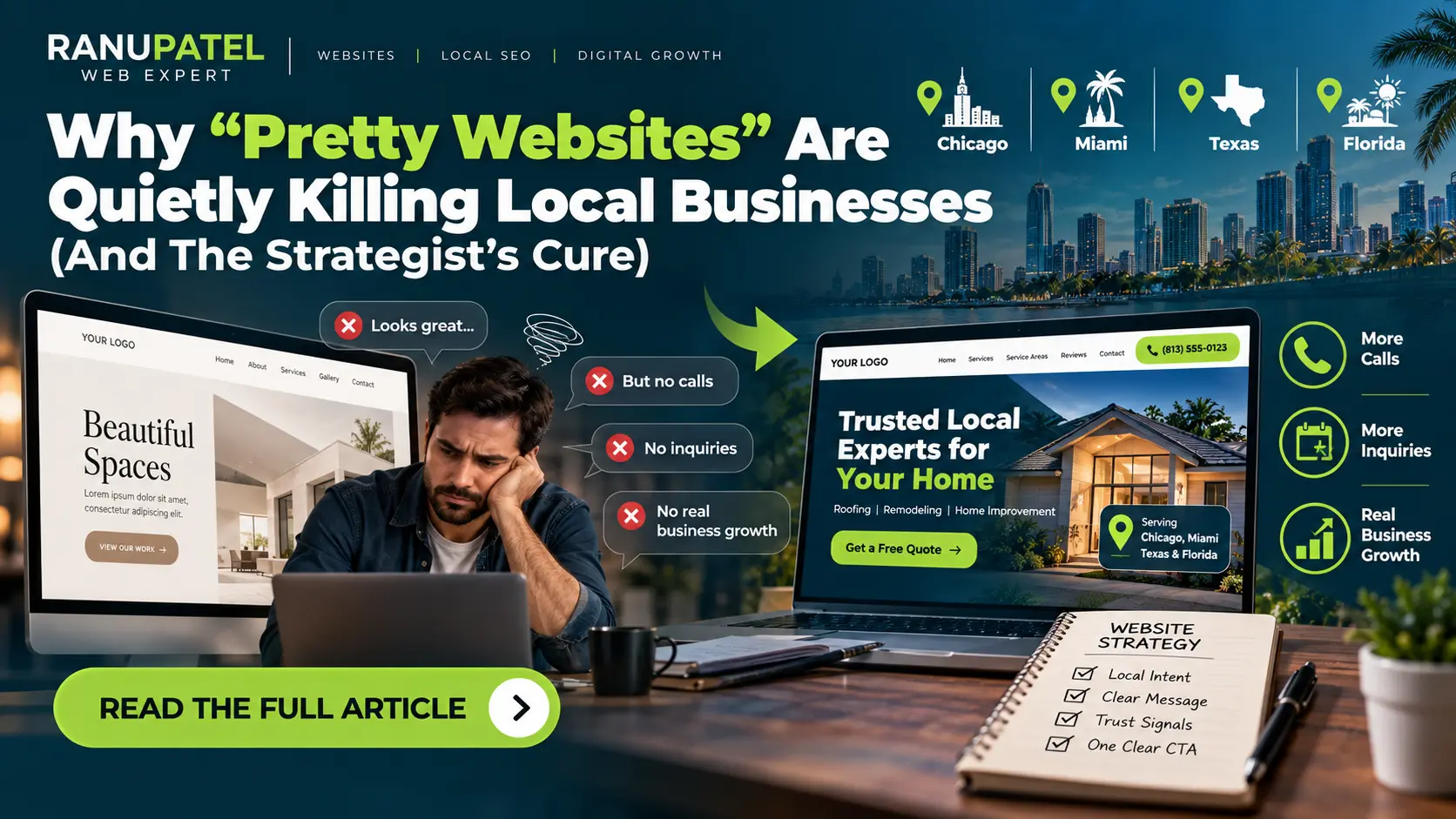
A pretty website fails local businesses in Chicago, Miami, Texas, and Florida because it is built to be admired, not to turn a searching stranger into a caller. The cure is a website conversion strategist who designs around local buyer intent, one clear next step, and measurable inquiries before choosing a single color.
If your site looks great but the phone stays quiet, the problem is rarely the paint. It is the plan underneath it.
Here is a scene we see constantly. A local owner pays for a beautiful redesign, hears compliments from friends, and waits. Three months later, traffic looks fine, inquiries do not, and nobody can explain why.
The cruel part is that nothing looks broken. A website can fail silently for years, because a bad design announces itself while a good-looking one hides its leak behind compliments. This guide explains why web design fails, and how owners in four competitive markets can fix it.
Why Do Beautiful Websites Fail to Generate Leads for Small Businesses in Chicago, Miami, Texas, and Florida?
Because beauty and persuasion are different skills. A homeowner in Houston or a patient in Tampa is not judging your typography. They are asking three quiet questions: Is this for me? Can I trust them? What do I do next?
A site that answers none of those clearly loses to an uglier competitor that answers all three. In practice, what we often see is a gorgeous homepage with a vague headline, a hidden phone number, and a contact form that asks for everything.
The “Brochure Website” Mistake
A brochure website describes the business. A conversion website helps a specific buyer decide. The mistake most teams make at this stage is writing about “our story” when the visitor wants proof, pricing context, and a safe next step. Brochure sites also bury what a local buyer wants most: confirmation that you serve their neighborhood and can help this week.
The Silent Exit
Most visitors never complain, never fill out a form, and never return. They leave within the first few seconds because the page failed to tell them quickly that they were in the right place. You cannot see this loss by looking at the site. You see it in the data: scroll depth, click paths, form starts versus completions, and calls from the page. If nobody measures those, nobody knows the site is leaking.
A redesign can lower your conversions. A dated site that clearly states who you serve and shows a phone number will often outperform a stunning one with a clever, vague headline. Design that delays the message costs you the lead.
Why Is a Generic Website So Costly in Competitive Markets Like Chicago and Miami?
Because in crowded markets, buyers compare quickly and your site is judged against five others in the same tab session. A generic page does not just fail to impress. It makes you look interchangeable.
Each market also behaves differently. A single national template cannot reflect that, which is why local intent mapping matters before design begins.
| Market | What Local Buyers Expect | Common Website Mistake | Strategic Fix |
|---|---|---|---|
| Chicago | Neighborhood-level relevance, clear credentials, seasonal readiness for harsh winters | One “Chicago” page for a city of many distinct neighborhoods | Service pages tied to real areas served, plus proof from local jobs |
| Miami | Speed, trust, and often English and Spanish options in a tourism- and hurricane-aware market | English-only copy and no storm-season messaging | Bilingual-ready key pages and clear urgency paths for emergencies |
| Texas | Local presence in a very large state with several major metros | Treating Houston, Dallas, Austin, and San Antonio as one audience | Separate city pages with genuine local detail, not copy-paste swaps |
| Florida | Seasonal demand, storm readiness, and licensing trust across many regions | Same message for Tampa, Orlando, Jacksonville, and South Florida | Region-specific proof, hurricane-season content, and visible credentials |
When this approach works: you serve a defined area and can show real local proof. When it fails: you create dozens of near-identical city pages with only the name changed. Search engines and buyers both see through that.
If you are in the Windy City, see how this plays out on our Chicago web design page. For South Florida, our Miami SEO consultant page shows the same strategy-first approach in a different market.
Freelance Web Designer vs Website Strategist: Which Should You Hire?
It depends on what you are actually buying. A freelance web designer is hired to make something look right. A freelance website strategist is hired to make something work. Many owners hire the first while expecting the second.
| Criteria | Freelance Web Designer | Website Strategist |
|---|---|---|
| Main output | Pixel-perfect mockups, WordPress templates, visual elements | Conversion architecture, messaging, page structure, tracking plan |
| Starts with | Your brand colors and inspiration sites | Your revenue goal, buyer intent, and current data |
| Success measured by | “Does this look good?” | “Does this generate inquiries?” |
| Best when | You already have a clear strategy and need clean execution | Your site exists but does not produce leads, or you are starting fresh |
| Fails when | Nobody has defined who the site is for or what it should do | You want only a quick visual refresh with no growth goal |
We cover this split in more depth in Freelancer vs Strategist: The Real Shift in Web Design & SEO. Chicago owners weighing options can also read Freelance Web Design Chicago vs Agency.
Shifting the Metric: The simplest rule of thumb we give owners is the Pipeline-First Test: for every page, ask “What inquiry does this page create?” If nobody can answer, the page is decoration.
Is a Template or Website Builder Enough for a Small Business Website?
Sometimes. A template or website builder can be a sensible start for a new business with a small budget and a simple offer. The trade-off is that templates suit everyone, which means they are optimized for no one.
- It works when: you are validating an idea, your service is simple, and you can write clear copy yourself.
- It fails when: you compete in a crowded city market, need strong local visibility, or rely on the site as your main lead source.
The hidden cost is the generic structure that comes with it: the same hero banner, the same three-icon row, the same weak call to action as thousands of other sites. Customers do not consciously notice. They simply feel nothing here is specifically for them.
Platform choice matters most when local search is the goal. Our breakdown of Wix vs WordPress for local SEO in Miami covers where each fits. Either way, the platform is rarely the problem. The missing plan is.
Will More Traffic Fix a Website That Does Not Convert?
No. This is the most common misdirected spend we see. Owners searching for how to increase website traffic often have a conversion problem, not a traffic problem. More visitors to a leaky page only makes the leak more expensive.
Imagine paying for ads, SEO, or social posts to bring people to a page that loses most of them within seconds. Doubling traffic doubles your cost while the bucket leaks at the same rate.
A healthier goal is a pipeline, not a visitor count: fewer, better-matched visitors landing on pages built for their exact question. It is a smaller number on the traffic report and a bigger number on the bank statement.
What Is the Strategist’s Cure? Conversion Rate Optimization Meets Website Architecture
The cure is not a redesign. It is a different order of operations: strategy first, structure second, design third. Done in that order, design becomes the finishing layer that makes a strong plan feel trustworthy.
Good conversion rate optimization is not tricks or pop-ups. It is removing the reasons a qualified visitor hesitates. Three elements carry most of the weight:
Your top screen must state who you help, what you do, and where, in plain words. One strong headline, one proof point, one clear action. Everything else supports that.
Every extra field, competing button, or vague label is a small tax on the visitor. Strategic sites offer one primary action per page. For many local owners, a visible tap-to-call button on mobile is the single biggest missed fix.
Search is shifting toward AI answers in Google AI Overviews, ChatGPT, Gemini, and Perplexity. These systems recommend businesses they can understand. That takes clear service pages, consistent business details, structured data, and genuine reviews: entity authority and search visibility engineering.
How Does the Ranu Patel Methodology Design for Intent and Engineer for Visibility?
Our process follows three steps, always in this order:
- Business diagnosis: We review revenue goals, traffic, calls, and conversion data before drawing anything. If the problem is not the website, we say so.
- Psychological and local mapping: We build layouts around how your ideal client decides, and around the city or region they are searching from.
- Sustainable growth support: We track results and keep refining, so the site improves as your business grows. Launch is a starting line, not a finish.
This is how we approach strategic website design services: the site is built as a lead system, with design serving the plan.
What Does a Website ROI Strategy Actually Look Like?
A real website ROI strategy starts with a number you can defend, not a feeling. Before any build, agree on what one inquiry is worth to you, then work backwards.
If one in four inquiries becomes a job, and you know what a job is worth, you can estimate the value of each new inquiry. That turns “should we redesign?” into a business decision instead of a taste debate.
- Track the actions that matter: calls, form submissions, booking clicks, and direction requests, not just visits.
- Tag the source: know whether an inquiry came from Google Maps, search, ads, or referrals.
- Review monthly: change one thing at a time so you learn what actually moved results.
How Do You Hire a Website Strategist in Chicago, Miami, Texas, or Florida?
Ask questions that reveal thinking, not just taste:
- “What will you measure, and how?” Strong answers mention calls, form submissions, and booked work, not page views.
- “Who is this site for, in which city?” If the answer is “everyone,” expect a generic result.
- “What would you change before redesigning?” A true strategist will sometimes recommend fixing messaging first.
- “Can I see before-and-after results, not just screenshots?”
Location matters less than you might think. Strategy and search work can be done remotely, as we do for Austin, Texas businesses on our Austin SEO consultant page. What matters is that your strategist understands your local market, not that they share your zip code.
A low-risk starting point is an audit before any build. Our SEO audit service reviews Google Business Profile, speed, local listings, schema, content, and reviews, so you know what is actually broken.
One caution: strategy cannot fix a weak offer or poor service. If reviews are poor or you cannot handle more work, fix that first.
Frequently Asked Questions About Website Strategy vs Web Design
What is the difference between a freelance web designer and a website strategist?
A designer focuses on how a site looks and is built. A strategist focuses on what the site must achieve and how visitors are guided to act. Many professionals do both, so ask who owns your results.
Do I need a Chicago-based web designer to rank in Chicago?
No. Rankings depend on relevance, content, reviews, and your Google Business Profile, not your designer’s address. Choose someone who understands Chicago neighborhoods and buyers.
Should my Miami business website be bilingual?
If a meaningful share of your customers prefers Spanish, then yes, at least on key service and contact pages. Done properly, it builds trust and widens your reach. Poor machine translation does the opposite.
Texas is huge. Do I need one website or several?
Usually one strong site with distinct, genuinely local pages for each market you serve. Houston, Dallas, Austin, and San Antonio behave like separate markets, so avoid copy-paste city pages.
I already have a beautiful website. Do I need to rebuild it?
Usually not. Start with an audit of messaging, structure, and data. Often the fix is a stronger headline, clearer calls to action, better service pages, and tracking.
How long does it take to see a return on a strategic website?
It depends on your starting point and market. Conversion improvements on existing traffic can show sooner than search growth, which builds over months. Be wary of anyone promising exact dates or revenue.
Is Your Website Design Problem Really a Strategy Problem?
Not sure whether your website has a design problem or a strategy problem? Request a free website and visibility review. You will get a plain-language read on what to fix first, with no obligation.