Generate more qualified leads through better websites, SEO, Local SEO, AI Search & conversion strategy.
Generating more website traffic doesn’t always result in more customers. Many businesses invest in websites, SEO, Google Ads or social media but still struggle to receive consistent enquiries. The reason often isn’t a lack of visibility — it’s a lack of strategy.
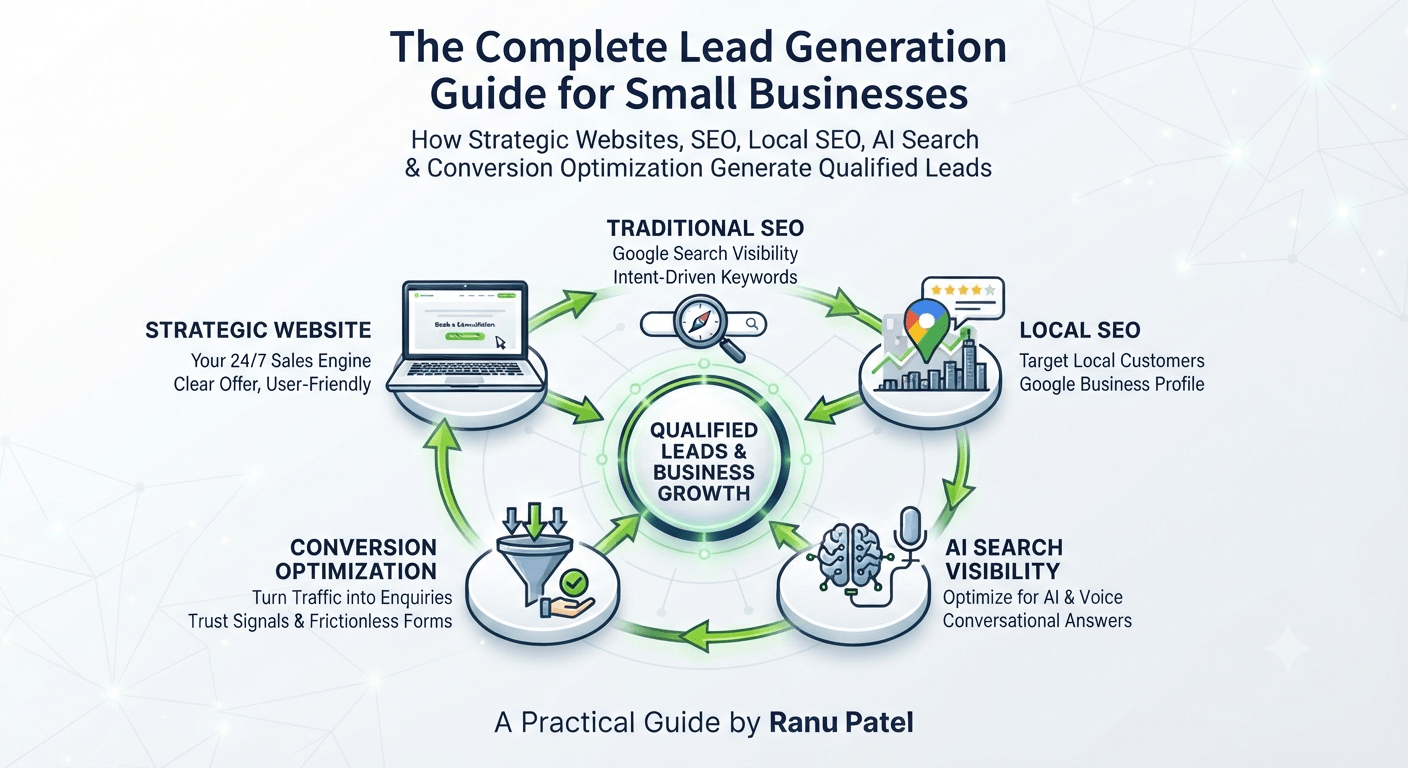
In this comprehensive guide, you’ll learn how successful businesses generate qualified leads by combining website strategy, Local SEO, Google Business Profile optimization, AI Search Visibility, conversion-focused design and customer trust. Whether you’re a manufacturer, architect, healthcare provider, consultant or local service business, these practical strategies will help you build a stronger lead generation system for long-term growth.
Introduction: Every Business Wants More Leads — But That’s Not the Real Challenge
Ask almost any business owner about their biggest marketing goal, and you’ll hear a familiar answer: “We need more leads.”
However, generating more leads isn’t simply about increasing website traffic or running more advertisements. Many businesses receive visitors from Google Search, Google Business Profile, referrals or social media every day. Yet only a small percentage of those visitors become enquiries or customers.
The difference often lies in the quality of the lead generation system — not the amount of traffic. A successful lead generation strategy helps attract the right audience, builds trust through valuable content and a professional online presence, and makes it easy for potential customers to take the next step.
Throughout this guide, you’ll discover how websites, SEO, Local SEO, AI Search Visibility, Google Business Profile, conversion optimization and customer psychology work together to create a predictable flow of qualified enquiries. Instead of relying on a single marketing channel, you’ll learn how to build a complete lead generation system that supports sustainable business growth.
Why This Guide Matters
Many businesses invest in isolated tactics: a new website, SEO services, Google Ads, social media campaigns, or Google Business Profile optimization. While each of these can contribute to growth, none of them consistently generate qualified leads on their own. Real results come from combining these elements into a strategy that supports the entire customer journey — from discovery to enquiry. That is exactly what this guide is designed to help you understand.
What Is Lead Generation? (And Why Most Businesses Get It Wrong)
A Simple Definition
Lead generation is the process of attracting people who are genuinely interested in your products or services and encouraging them to take the next step — whether that’s calling your business, submitting an enquiry form, requesting a quote, booking a consultation or sending a message.
However, not every enquiry is valuable. A business that receives 100 random enquiries may achieve less than another business that receives 20 enquiries from well-qualified prospects. That is why successful businesses focus on qualified lead generation, not simply generating more traffic or collecting more contact forms.
Traffic vs Leads vs Qualified Leads
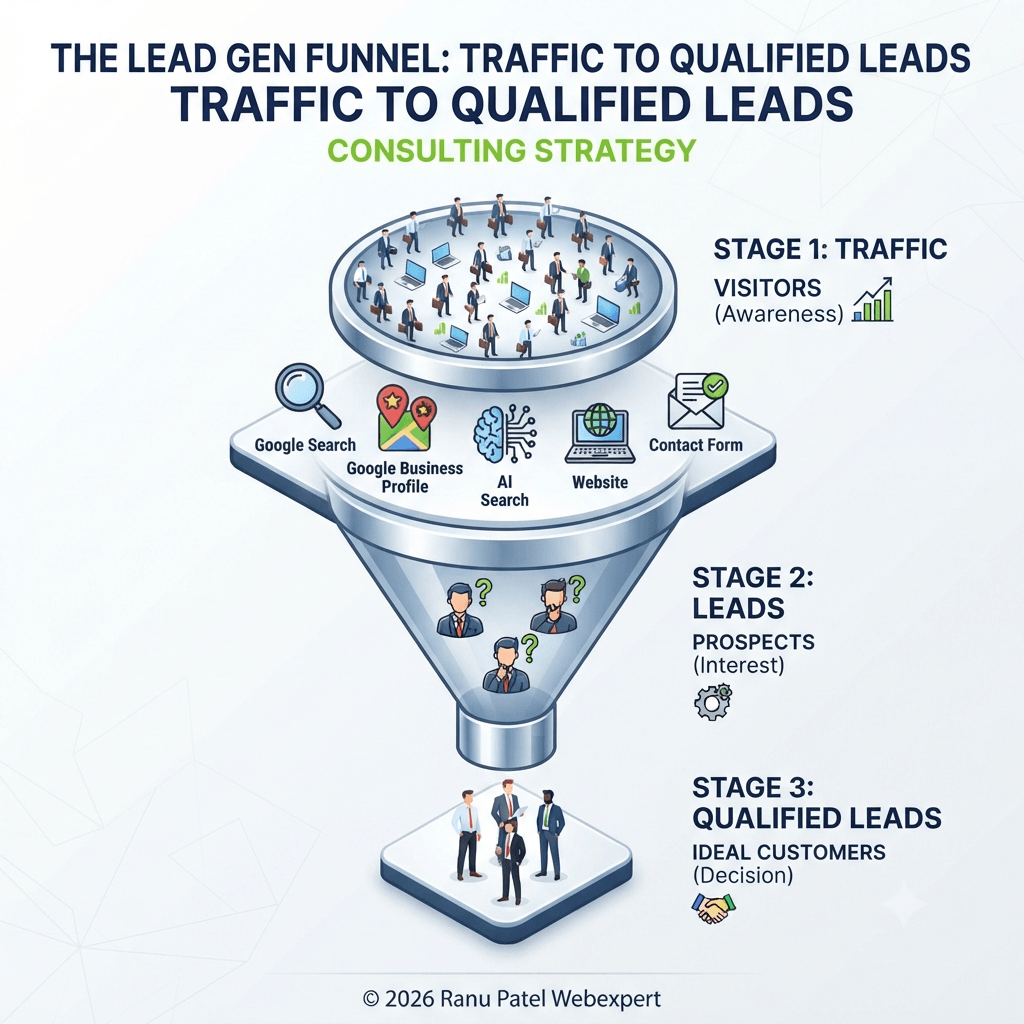
Many business owners use these terms interchangeably, but they represent different stages of the customer journey.
| Traffic | Leads | Qualified Leads |
|---|---|---|
| Visitors who discover your business | People who contact your business | Prospects who genuinely need your service and are more likely to become customers |
| May arrive through Google, AI Search, social media, referrals or ads | Complete a form, call, email, WhatsApp or book an appointment | Have the right budget, clear requirements and purchase intent |
| Doesn’t automatically generate revenue | Shows initial interest | Creates real business opportunities |
Example
Imagine two businesses.
Business A
- 10,000 website visitors
- 180 enquiries
- 8 paying customers
Business B
- 2,000 website visitors
- 45 enquiries
- 20 paying customers
Business B generated fewer enquiries but achieved more customers because it attracted the right audience and converted them effectively.
Focus on attracting the right visitors rather than simply increasing traffic.
Why Most Small Businesses Struggle to Generate Qualified Leads
One of the biggest misconceptions in digital marketing is that publishing a website or ranking on Google automatically leads to business growth. In reality, lead generation depends on several connected factors working together.
During website reviews, I frequently notice businesses investing heavily in one area while overlooking others. For example, a company may have an attractive website but no clear calls to action. Another might rank well in search results but provide little evidence of expertise or customer trust. These gaps make it difficult for potential customers to take the next step.
Common Reasons Businesses Lose Leads
1. They focus on traffic instead of customer intent
More visitors don’t always mean more customers. A smaller audience with stronger buying intent often produces better results than a large audience with little interest in your services.
2. Their website doesn’t build confidence
When visitors arrive on your website, they quickly evaluate whether they understand what your business offers, whether they can trust your company, whether you’ve solved similar problems before, and whether it’s easy to contact you. If these questions remain unanswered, visitors often continue comparing other businesses.
3. There is no clear customer journey
Some websites leave visitors wondering what to do next. Instead, guide them with a logical flow:
Search → Website → Trust → Enquiry → Consultation → Customer
Every page should help users move confidently to the next step.
4. They ignore local visibility
For businesses serving specific locations, local visibility matters. An optimized Google Business Profile, accurate business information, customer reviews, local service pages and location-specific content help nearby customers discover and trust your business.
5. They treat marketing channels as separate activities
SEO, websites, Google Business Profile, content marketing, AI Search and paid advertising should support one another — not operate independently. Businesses that connect these elements into one system usually achieve more consistent results.
Over the years, I’ve noticed that businesses rarely struggle because they lack a website or marketing tools. More often, they struggle because those tools aren’t connected by a clear strategy. A professional website, search visibility, helpful content, strong trust signals and a simple enquiry process should work together as one lead generation system — not as isolated activities.
Before investing more in marketing, ask yourself: Are we attracting the right audience? Does our website clearly explain our value? Do visitors see evidence that they can trust us? Is it easy for someone to contact us? Are all of our marketing channels working together? If the answer to any of these is “no,” improving those areas may have a greater impact than simply trying to increase traffic.
The Complete Lead Generation System
Why Lead Generation Is a System — Not a Single Marketing Channel
One of the biggest misconceptions in digital marketing is believing that one marketing channel alone can consistently generate business. Some companies rely only on SEO. Others depend entirely on Google Ads or social media. Some invest in a new website and expect enquiries to start arriving automatically. In reality, sustainable lead generation happens when multiple components work together.
Think of your business like a well-designed machine. Each part has a specific purpose, and if one part isn’t working, the entire system becomes less effective. A Google Ads campaign can bring visitors to your website. A professional website builds trust. Helpful content answers questions. Google Reviews provide social proof. A clear call-to-action encourages enquiries. Fast follow-up turns enquiries into customers. If any one of these elements is weak, potential customers may leave before taking action.
Lead generation isn’t about finding one magic solution. It’s about building a complete system that supports the customer at every stage of their journey.
The Lead Generation Framework
Imagine the customer journey as a series of connected steps, where each stage influences the next.
- Visibility
- Traffic
- Trust
- Engagement
- Enquiry
- Follow-up
- Customer
- Referral
Stage 1: Visibility — Helping the Right People Discover Your Business
Before anyone can become your customer, they need to know your business exists. People discover businesses through different channels depending on their needs — Google Search, Google Business Profile, AI-powered search platforms, referrals, social media, Google Ads, Meta Ads, email marketing, industry directories and word of mouth.
Rather than trying to appear everywhere, focus on the channels that match your audience’s search behaviour. A manufacturer may rely heavily on Google Search and referrals. A local dentist may receive many enquiries through Google Business Profile. A B2B consultant may generate opportunities through LinkedIn. The right mix depends on your industry, services and ideal customer.
Visibility checklist:
- Search-friendly website
- Google Business Profile
- Local SEO
- Helpful content
- AI Search visibility
- Social media presence
- Consistent business information
Stage 2: Traffic — Attracting the Right Visitors
Visibility creates opportunities. Traffic brings people to your digital assets. However, all traffic is not equal. The goal isn’t to attract the largest audience — it’s to attract people who genuinely need your services.
Someone searching for “how to choose a website designer for manufacturers” is often much closer to making a decision than someone searching “what is a website?” Intent matters more than numbers. That’s why understanding your audience’s questions is more valuable than chasing broad keywords.
Sources of quality traffic: Organic SEO, Local SEO, Google Business Profile, AI Search platforms, Google Ads, social media, referrals, email campaigns and industry partnerships.
Stage 3: Trust — Turning Visitors into Prospects
Once someone visits your website, they immediately begin evaluating your business. They may ask: Does this company understand my needs? Have they worked with businesses like mine? Can I trust their expertise? Do they appear professional? Is it easy to contact them?
Your website answers these questions through clear messaging, relevant service pages, customer reviews, testimonials, a portfolio, case studies, educational content, an About Us page, team information and contact details. Every positive signal reduces uncertainty.
Trust checklist:
- Professional website
- Real customer reviews
- Case studies
- Industry expertise
- Helpful blog articles
- Clear contact information
- Secure website
- Transparent process
Stage 4: Engagement — Helping Visitors Take the Next Step
Even if someone trusts your business, they may still leave if the next step isn’t obvious. Your website should gently guide visitors with actions such as: book a consultation, request a website audit, download a checklist, ask a question, schedule a discovery call or request a quote. Avoid overwhelming visitors with too many competing actions. Instead, provide one clear path that matches the page’s purpose.
Engagement checklist:
- Clear CTA
- Simple forms
- Click-to-call
- WhatsApp (if appropriate)
- Easy navigation
- Helpful FAQs
Stage 5: Enquiry — Creating Qualified Opportunities
Not every enquiry is the right enquiry. The objective is to attract people who need your services, understand your value and are likely to become customers. A thoughtful enquiry form can help qualify leads by asking relevant questions about business type, goals, timeline, budget (where appropriate) and project requirements. This helps create more meaningful conversations from the beginning.
Stage 6: Follow-Up — The Most Overlooked Stage
Many businesses invest heavily in marketing but respond slowly to new enquiries. Response time influences customer perception. People appreciate businesses that acknowledge enquiries promptly, communicate clearly, explain the next steps and keep promises. A positive follow-up experience reinforces the trust you’ve already built.
Stage 7: Customer Experience — Delivering on Your Promise
Generating a lead is only the beginning. Long-term business growth comes from consistently delivering value. Satisfied customers often become repeat clients, referral sources, positive reviewers and brand advocates. Exceptional customer experiences strengthen your reputation and support future lead generation.
Stage 8: Referrals — Turning Customers into Your Best Marketing Channel
One happy customer can introduce your business to several others. Encourage referrals by delivering excellent service, staying connected after project completion, asking for honest feedback and making it easy for customers to recommend you. Referrals often produce highly qualified leads because trust already exists before the first conversation.
Lead generation isn’t a single tactic. It’s a connected system where each stage supports the next. If your business focuses only on generating traffic but ignores trust, user experience or follow-up, you’ll likely lose opportunities. The businesses that consistently generate qualified enquiries usually invest in improving the entire customer journey — not just one marketing channel.
One pattern I’ve observed across website audits is that businesses often ask, “Which marketing channel should we invest in?” A better question is: “Which stage of our lead generation system is currently weakest?” For some businesses, the answer is visibility. For others, it’s trust, conversion or follow-up. Identifying and strengthening the weakest part of the system often produces better results than simply spending more on advertising or publishing more content.
10 Proven Lead Generation Strategies That Actually Work
One of the most common questions I hear from business owners is: “What’s the best way to generate more leads?” The honest answer is that it depends on your business, industry, target audience and goals. A local dentist, a manufacturing company, an architect and a roofing contractor won’t all generate leads in the same way. However, the most successful businesses usually combine several complementary strategies instead of relying on just one marketing channel. Here are ten proven approaches that work well together.
1. Build a Website That Converts Visitors into Enquiries
Your website is more than an online brochure — it should function as your 24/7 lead generation system. A high-performing website should clearly explain your services, answer customer questions, demonstrate expertise, build trust through reviews and case studies, and make it easy to contact your business. Simply having a modern design isn’t enough; your website should guide visitors toward taking action.
Website checklist:
- Fast loading
- Mobile responsive
- Clear messaging
- Strong CTA
- Contact information
- Trust signals
- SEO-friendly structure
A beautiful website that doesn’t generate enquiries is simply an expensive brochure.
2. Invest in SEO That Matches Customer Intent
SEO isn’t about ranking for as many keywords as possible — it’s about attracting people who are actively looking for your services. Instead of targeting only “website,” create content that answers questions such as: How much does a business website cost? Why isn’t my website generating enquiries? How do I choose a website designer? Intent-driven content attracts visitors who are closer to making a decision.
SEO checklist:
- Service pages
- Educational blogs
- Internal links
- Technical SEO
- EEAT
- Structured data
- Local optimization
3. Optimize Your Google Business Profile
If you serve customers in specific locations, your Google Business Profile is one of your most valuable lead generation assets. A complete profile helps people discover your business, read reviews, view photos, call directly, request directions and visit your website. Regular updates also demonstrate that your business is active.
Google Business Profile checklist:
- Correct categories
- Updated services
- Quality photos
- Customer reviews
- Weekly posts
- Accurate contact details
4. Publish Helpful Educational Content
Customers rarely make immediate buying decisions — they research first. Helpful content answers their questions before they contact you. Examples include guides, checklists, FAQs, comparisons, industry insights and case studies. Educational content builds trust while improving visibility in traditional search engines and AI-powered search experiences.
Content ideas: common mistakes, buying guides, cost guides, industry trends, step-by-step tutorials and customer questions.
5. Use Google Ads for High-Intent Searches
SEO builds long-term visibility. Google Ads can help you appear for high-intent searches while your organic presence continues to grow. Someone searching “website audit consultant” may already be ready to enquire. When running Google Ads, match ads with dedicated landing pages, track conversions, improve Quality Score, and test headlines and calls-to-action. Advertising works best when supported by a strong website.
6. Build Trust Through Customer Reviews
Before contacting your business, many people look for reassurance. Encourage satisfied customers to leave honest reviews on Google, industry platforms and Facebook (where appropriate). Respond professionally to every review. Reviews help future customers understand what it’s like to work with your business.
7. Improve Conversion Rates Before Increasing Traffic
Many businesses focus on attracting more visitors. However, improving conversion rates can often produce better results. Increasing your enquiry rate from 2% to 4% can potentially double enquiries without increasing traffic. Small improvements may include better headlines, clearer CTAs, simpler forms, faster pages and better trust signals.
8. Use AI Search Visibility to Reach Emerging Search Audiences
More people are discovering businesses through AI-powered search experiences such as Google AI Overviews, ChatGPT, Gemini and Perplexity. These systems often prefer well-structured content, helpful answers, strong expertise, clear formatting and consistent entity information. Creating content for people first also supports visibility in these emerging search experiences.
9. Nurture Leads After the First Enquiry
Generating an enquiry is only the beginning. Some prospects need time before making a decision. Stay connected through follow-up emails, helpful resources, discovery calls, educational newsletters and progress updates. Professional follow-up demonstrates reliability and keeps your business top of mind.
10. Measure, Improve, Repeat
Lead generation is an ongoing process. Review your performance regularly. Useful metrics include website enquiries, conversion rate, traffic sources, Google Business Profile insights, Search Console performance, cost per lead (for paid campaigns), lead quality and customer acquisition rate. Continuous improvement is often more valuable than constantly changing your marketing strategy.
Common Lead Generation Mistakes
Even experienced businesses make avoidable mistakes. Some of the most common include:
- ❌ Expecting instant results
- ❌ Focusing only on rankings
- ❌ Ignoring customer trust
- ❌ Using generic messaging
- ❌ Publishing thin content
- ❌ Weak calls-to-action
- ❌ Slow response times
- ❌ Poor mobile experience
- ❌ No tracking or analytics
- ❌ No follow-up process
Lead Generation Success Checklist
Visibility: ✔ SEO ✔ Local SEO ✔ Google Business Profile ✔ AI Search
Website: ✔ Mobile-friendly ✔ Fast loading ✔ Clear messaging ✔ Service pages ✔ Contact information
Trust: ✔ Google Reviews ✔ Testimonials ✔ Case studies ✔ About Us page ✔ Portfolio
Conversion: ✔ Strong CTAs ✔ Simple forms ✔ Landing pages ✔ Conversion tracking
Growth: ✔ Analytics ✔ Regular content ✔ Follow-up process ✔ Ongoing optimization
Businesses often ask whether they should invest in SEO, Google Ads, social media or a new website. The better question is: “Which part of our lead generation system is limiting growth?” For one business, the answer may be poor visibility. For another, it could be low trust, weak messaging or slow follow-up. The businesses that grow consistently don’t chase every new marketing trend — they improve the weakest part of their system and measure the results.
Lead Generation Looks Different for Every Business
A common mistake businesses make is copying another company’s marketing strategy without considering their own customers, industry or buying journey. The approach that works for a local dental clinic will be very different from what a manufacturing company or an architectural firm needs. The key is to understand how your ideal customers search, compare businesses and make decisions.
Scenario 1: Manufacturing Company
Challenge: A manufacturing business has an attractive website but receives very few enquiries from potential buyers. Most visitors leave without exploring product pages or submitting an enquiry.
What usually happens: Many manufacturers rely on word of mouth, existing customers, trade exhibitions and dealer networks. While these channels remain valuable, today’s buyers often begin their research online before contacting suppliers. If your website doesn’t clearly explain your capabilities or products, buyers may move on to a competitor.
Recommended strategy:
- SEO for product and industry keywords
- Technical product pages
- Downloadable catalogs
- Case studies
- Industry-specific landing pages
- Google Business Profile
- LinkedIn thought leadership
- ✔ Website speed optimization
- Clear enquiry forms
Expected outcome: Instead of attracting random visitors, the website begins generating enquiries from businesses actively looking for manufacturing partners.
Scenario 2: Architects & Interior Designers
Challenge: An architect has an excellent portfolio but receives very few enquiries through the website.
Why this happens: Potential clients often make decisions based on trust and visual credibility. If the website doesn’t showcase completed projects, explain the design process or highlight customer experiences, visitors may hesitate to make contact.
Recommended strategy:
- Portfolio galleries
- Project case studies
- Google Reviews
- Before-and-after transformations
- Local SEO
- Service-specific landing pages
- Educational blogs
- Frequently Asked Questions
Expected outcome: The website becomes a digital portfolio that builds confidence before the first consultation.
Scenario 3: Dental Clinic
Challenge: The clinic ranks well for several local searches but appointment enquiries remain inconsistent.
Why this happens: Patients want reassurance before choosing a healthcare provider. They compare reviews, experience, clinic photos, services, accessibility and the appointment process. If this information isn’t easy to find, they may continue searching.
Recommended strategy:
- Google Business Profile optimization
- Patient testimonials
- Dentist profiles
- Treatment pages
- Local SEO
- Frequently Asked Questions
- Appointment booking
- Educational articles
Expected outcome: Patients gain confidence before making contact, increasing appointment enquiries.
Scenario 4: Roofing & HVAC Companies (USA & Canada)
Challenge: The company invests in Google Ads but receives expensive leads with inconsistent quality.
Why this happens: Paid advertising can attract visitors quickly, but the website must still persuade them to enquire. If landing pages don’t answer key questions or build trust, advertising costs increase without improving results.
Recommended strategy:
- Dedicated landing pages
- Google Ads
- Local SEO
- Service area pages
- Customer reviews
- Emergency contact options
- Before-and-after projects
- Financing information (if applicable)
Expected outcome: Improved lead quality and more efficient use of advertising spend.
Scenario 5: Professional Service Firms
(Law firms, accountants, consultants, financial advisors)
Challenge: Potential clients visit the website but rarely request consultations.
Why this happens: Professional services rely heavily on credibility. Visitors want to understand experience, specialization, process, credentials and client success stories. Without these trust signals, they may continue comparing firms.
Recommended strategy:
- Detailed service pages
- Team profiles
- Founder story
- Educational blogs
- Case studies
- Google Reviews
- Consultation booking
- Strong About Us page
Expected outcome: Higher-quality enquiries from clients who already understand your expertise.
What These Examples Have in Common
Although every industry is different, successful lead generation consistently depends on the same foundation:
- Increase visibility
- Attract the right visitors
- Build trust
- Guide visitors clearly
- Encourage enquiries
- Respond professionally
- Deliver excellent service
- Generate referrals
The tools may change, but the customer journey remains remarkably similar.
Across industries, one pattern stands out: businesses often invest in attracting visitors before ensuring their website is ready to convert them. Whether you’re a manufacturer in Ahmedabad, a dental clinic in Toronto, a roofing contractor in Dallas or an architect in London, the fundamentals remain the same. People don’t contact a business simply because they find it — they contact the business that makes them feel confident enough to take the next step.
How to Measure Lead Generation Success (The KPIs That Actually Matter)
Many businesses celebrate when they receive more website visitors or a higher number of enquiries. However, these numbers alone don’t tell the whole story. The real question is: are your marketing efforts generating qualified business opportunities that lead to revenue?
For example, receiving 100 enquiries from people outside your service area or with unrealistic budgets may create more work without improving business growth. On the other hand, 20 well-qualified enquiries from your ideal customers can have a far greater impact. That is why successful businesses focus on quality, efficiency and continuous improvement — not just volume.
The Lead Generation Metrics That Matter
1. Website Enquiries
This is one of the simplest indicators of whether your website is encouraging visitors to take action. Track contact form submissions, phone calls, email enquiries, appointment requests and WhatsApp messages (where applicable). If traffic increases but enquiries remain the same, your website may need improvements in messaging, trust or calls-to-action.
2. Qualified Leads
Not every enquiry represents a genuine business opportunity. Ask whether the person matches your ideal customer profile, whether they’re looking for the services you provide, whether the project is a good fit for your expertise, and whether they’re located within your service areas. Improving lead quality often creates better business outcomes than simply increasing enquiry numbers.
3. Website Conversion Rate
Your conversion rate measures how effectively your website turns visitors into enquiries. For example, 1,000 visitors and 40 enquiries gives a conversion rate of 4%. Rather than focusing only on increasing traffic, look for ways to improve the percentage of visitors who take the next step. Small improvements in conversion can produce significant long-term results.
4. Traffic Sources
Understanding where visitors come from helps you invest in the right marketing channels. Common sources include organic search (SEO), Google Business Profile, direct visits, referrals, Google Ads, social media, email campaigns and AI-powered search experiences. Each source plays a different role in your lead generation system, so reviewing this regularly helps you understand which channels contribute to qualified enquiries.
5. Google Business Profile Performance
If your business serves local customers, your Google Business Profile provides valuable insights. Monitor trends such as profile views, website clicks, phone calls, direction requests, photo engagement and search queries. These insights help you understand how nearby customers discover and interact with your business.
6. Search Visibility
Improving visibility is often the first step toward generating more qualified leads. Useful indicators include keyword rankings, search impressions, click-through rate (CTR), indexed pages and organic traffic growth. However, always interpret these alongside enquiry data — visibility without enquiries may indicate a gap elsewhere in the customer journey.
7. Customer Acquisition Cost (For Paid Campaigns)
If you’re using Google Ads or Meta Ads, compare the cost of acquiring new customers rather than focusing only on clicks. Campaign A may have a lower cost per click but few qualified enquiries, while Campaign B has a higher cost per click but better-quality enquiries and more completed sales. The second campaign may provide greater business value despite appearing more expensive.
8. Customer Lifetime Value
Some businesses focus only on the first sale. However, long-term customers often provide greater value through repeat purchases, ongoing projects, referrals and positive reviews. When evaluating lead generation success, consider the long-term relationships your marketing creates.
Simple Lead Generation Dashboard
Review these indicators every month.
| KPI | Why It Matters | Goal |
|---|---|---|
| Website Visitors | Understand overall visibility | Steady, relevant growth |
| Website Enquiries | Measure visitor engagement | More qualified enquiries |
| Conversion Rate | Improve website performance | Continuous improvement |
| Google Business Profile Actions | Track local engagement | More calls, clicks and directions |
| Organic Search Traffic | Measure SEO progress | Sustainable growth |
| AI Search Mentions | Understand emerging visibility | Increasing presence over time |
| Paid Campaign Results | Evaluate advertising efficiency | Better return on investment |
| Customer Referrals | Measure satisfaction | More repeat business and referrals |
Tools That Can Help
You don’t need dozens of marketing platforms. For most small businesses, these tools provide valuable insights:
- Website analytics: Google Analytics 4 (GA4), Microsoft Clarity
- Search performance: Google Search Console
- Local visibility: Google Business Profile Insights
- SEO monitoring: Ahrefs or Semrush (optional), Google Keyword Planner (for keyword research)
- Lead management: CRM software suited to your business, email tracking tools, appointment scheduling systems
Choose tools that help you make better decisions rather than collecting data you never use.
Common Measurement Mistakes
Avoid relying on vanity metrics alone. Common mistakes include:
- ❌ Celebrating traffic while ignoring conversions
- ❌ Tracking rankings without reviewing enquiries
- ❌ Focusing only on clicks instead of customer quality
- ❌ Ignoring follow-up speed
- ❌ Measuring activity rather than business outcomes
Marketing should ultimately support business growth — not just reports.
One pattern I’ve consistently observed is that businesses often measure what is easiest to count rather than what matters most. Website traffic, social media followers and keyword rankings are useful indicators, but they don’t automatically translate into business growth. The metrics that deserve the most attention are those that reflect real customer behaviour — qualified enquiries, meaningful conversations, repeat clients and referrals. When you focus on these outcomes, your marketing decisions become more strategic and more sustainable.
Successful lead generation is not about collecting more numbers. It is about creating more opportunities with the right customers. By measuring visibility, trust, conversion and customer outcomes together, you gain a much clearer understanding of what is working and where improvements are needed. The businesses that grow consistently are rarely the ones chasing every new marketing trend — they are the ones that measure, learn, improve and repeat.
Frequently Asked Questions About Lead Generation
1. What is lead generation?
Lead generation is the process of attracting potential customers who are interested in your products or services and encouraging them to take the next step, such as requesting a quote, booking a consultation, calling your business or completing an enquiry form. The goal is not simply to increase website traffic but to generate qualified leads that are more likely to become paying customers.
2. Why is lead generation important for small businesses?
Lead generation creates a predictable way to attract new business opportunities. Instead of relying only on referrals or repeat customers, businesses can build a sustainable system that consistently generates enquiries through their website, search engines, local search, content and digital marketing.
3. What is the difference between traffic and qualified leads?
Website traffic measures the number of people visiting your website. Qualified leads are visitors who genuinely need your services, match your ideal customer profile and are more likely to become customers. Generating qualified leads is usually more valuable than simply increasing visitor numbers.
4. Which marketing channel generates the best leads?
There is no single best channel. For most businesses, the strongest results come from combining SEO, Local SEO, Google Business Profile, helpful content, website optimization, Google Ads (when appropriate), customer reviews and AI Search visibility. The ideal mix depends on your industry, location and business goals.
5. Does SEO generate leads?
Yes, when it attracts people who are actively searching for your products or services. Effective SEO focuses on understanding customer intent, creating helpful content and improving website experience — not simply ranking for more keywords.
6. Is Google Business Profile important for lead generation?
Absolutely. For businesses serving local customers, an optimized Google Business Profile helps increase visibility in local search results, Google Maps and mobile searches. It also allows potential customers to call, request directions, visit your website and read reviews before contacting you.
7. How can I improve my website’s lead generation?
Start by reviewing whether your website clearly explains your services, builds trust through reviews and case studies, loads quickly, works well on mobile devices, includes clear calls-to-action and makes it easy to contact your business. Small improvements in these areas often lead to better enquiry rates.
8. How long does lead generation take?
The timeline depends on the marketing approach. SEO and content marketing generally build momentum over several months. Google Ads can generate enquiries more quickly but require ongoing optimization. Website improvements may increase conversion rates soon after implementation. Lead generation should be viewed as a long-term business strategy rather than a one-time campaign.
9. Can AI improve lead generation?
AI can support lead generation by helping businesses create better content, improve search visibility, analyze customer behaviour and streamline repetitive marketing tasks. However, sustainable results still depend on providing genuine expertise, trustworthy information and a positive customer experience.
10. How do I know if my lead generation strategy is working?
Review indicators such as qualified enquiries, website conversion rate, Google Business Profile interactions, organic search performance, customer acquisition trends, repeat business and referrals. These metrics provide a more complete picture than website traffic alone.
11. What industries benefit most from lead generation?
Almost every industry can benefit from a structured lead generation strategy, including manufacturers, architects, interior designers, dental clinics, healthcare providers, law firms, roofing companies, HVAC businesses, professional service firms and educational institutions. The strategy should be adapted to how customers search and make decisions within each industry.
12. What is the first step to improving lead generation?
Begin with a website and digital presence audit. Review your visibility, messaging, trust signals, user experience and conversion paths. Understanding where potential customers are dropping off makes it easier to prioritize meaningful improvements.
Common Lead Generation Myths
Many businesses delay growth because they believe common misconceptions. Let’s address a few.
Myth 1: More Traffic Always Means More Customers
Not necessarily. The quality of your visitors and your ability to convert them matter far more than raw traffic numbers.
Myth 2: A Beautiful Website Will Generate Leads Automatically
A visually appealing website is valuable, but it also needs clear messaging, trust signals, SEO, strong calls-to-action and easy navigation. Design supports lead generation — it doesn’t replace strategy.
Myth 3: SEO Works Without Good Content
Search engines and AI-powered search experiences prioritize helpful, relevant content. Publishing valuable resources for your audience is an essential part of long-term SEO.
Myth 4: Google Ads Solve Every Marketing Problem
Advertising can increase visibility, but it cannot compensate for poor messaging, weak landing pages or a confusing website. Marketing channels work best when supported by a strong lead generation system.
Myth 5: Lead Generation Is a One-Time Project
Successful businesses treat lead generation as an ongoing process. They continuously measure performance, improve their website, publish helpful content and adapt to changing customer behaviour.
Your 90-Day Lead Generation Action Plan
Improving lead generation doesn’t require changing everything at once. A structured plan helps create sustainable progress.
Month 1: Strengthen Your Foundation
- Audit your website.
- Review your Google Business Profile.
- Update service pages.
- Improve homepage messaging.
- Add clear calls-to-action.
- Ensure mobile responsiveness.
- Check page speed.
- Add or refresh customer testimonials.
Month 2: Improve Visibility
- Publish two helpful blog articles.
- Optimize local SEO.
- Build internal links.
- Update Google Business Profile posts.
- Add FAQ schema.
- Review Search Console data.
- Improve title tags and meta descriptions.
Month 3: Increase Conversions
- Review enquiry forms.
- Test landing pages.
- Improve conversion tracking.
- Monitor website analytics.
- Request additional Google Reviews.
- Publish a case study.
- Evaluate lead quality.
Repeat this cycle every quarter and refine your strategy based on real data.
Final Thoughts
Generating more leads isn’t about finding a secret marketing tactic. It’s about creating a system that helps the right people discover your business, understand your expertise, trust your brand and confidently take the next step.
Whether your customers find you through Google Search, Google Business Profile, AI-powered search, referrals or paid advertising, they all go through a similar decision-making journey. They compare businesses. They look for evidence. They evaluate credibility. They decide who feels most capable of solving their problem.
Businesses that consistently generate qualified enquiries are rarely the ones doing one thing exceptionally well. They are the ones connecting visibility, trust, user experience and follow-up into one complete lead generation strategy.
Ready to Build a Better Lead Generation System?
If your business is receiving website visitors but not enough qualified enquiries, the issue may not be visibility alone. A structured review of your website, SEO, Local SEO, Google Business Profile, AI Search visibility and conversion strategy can help identify where potential customers may be dropping off — and what practical improvements could help create more qualified business enquiries.
Request a Website & Lead Generation Audit