Digital Architecture & Conversion Strategy
By Ranu Patel | Founder & Website Strategist | Experience: 16+ Years | Updated: August 2026 | ~15 min read
Executive Summary: Should you send prospects to a full website or a dedicated landing page? The most effective lead generation systems do not choose one over the other; they deploy both strategically. A website builds organic authority, establishes multi-layered trust (E-E-A-T), and educates research-driven prospects. A dedicated landing page removes all external distractions to maximize conversion rates on targeted ad campaigns. This guide breaks down the structural differences, traffic intent matching, industry use cases, and a 30-day implementation plan.
Website or Landing Page: What Should Your Business Use to Generate Qualified Leads?
If you’re investing in SEO, Google Ads, Local SEO, social media, or other digital marketing channels, you may eventually face an important question: Should you send potential customers to your website or to a dedicated landing page?
The answer isn’t simply “website” or “landing page.” A well-planned website and a focused landing page serve different purposes. In many cases, the strongest lead generation strategy uses both.
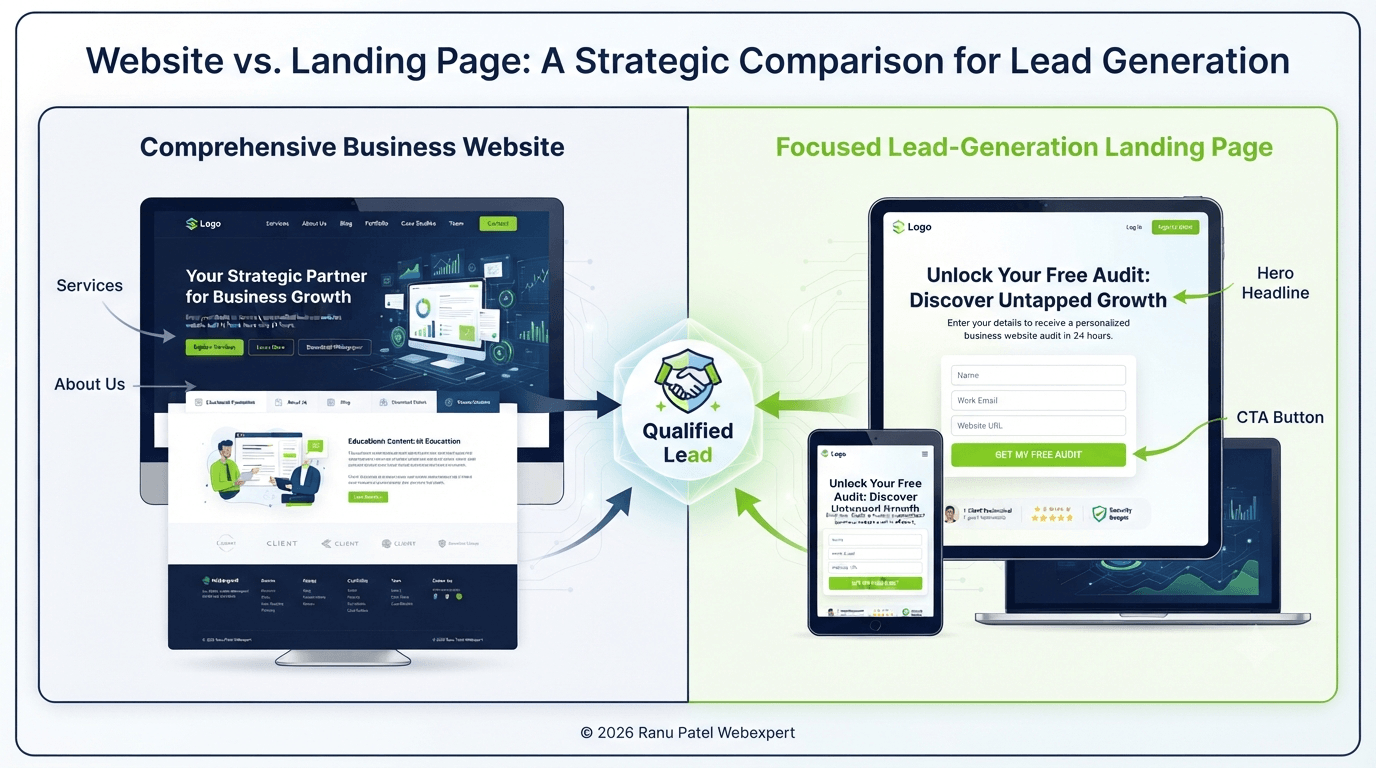
Your website helps people discover your business, understand your expertise, explore your services, and build trust. A landing page removes unnecessary distractions and focuses the visitor on one specific action—such as booking a consultation, requesting an audit, submitting an enquiry, or requesting a quote.
So the real question is not: “Which is better?” It is: “Which experience is best for this customer, this offer, and this stage of the buying journey?”
Understanding the Assets: What Is a Website vs. a Landing Page?
What Is a Website?
A business website is your broader digital presence. It usually contains multiple pages that help visitors understand who you are, what you offer, why they should trust you, and how they can contact you.
A typical service business website includes:
- Homepage & About Page
- Service, Industry & Location Pages
- Blog, Case Studies & Testimonials
- FAQs & Contact Page
Supports long-term visibility & authority:
SEO, Local SEO, AI Search Visibility, brand discovery, customer education, and multi-service trust building.
What Is a Landing Page?
A landing page is a focused page designed around a specific campaign, audience, offer, or action. Instead of asking visitors to explore an entire website, it gives them one clear reason to act.
Common landing page campaigns:
- Free website or lead generation audit
- Google Ads / Meta Ads campaigns
- Specific consultations (e.g., Dental Implant, Roofing Estimate)
- Manufacturing enquiry or downloadable guides
Core Operational Job:
Removes main navigation menus and focuses attention entirely on getting the right visitor to take the intended next step.
Real-World Example: Someone searching for a website designer in Ahmedabad may first discover your website through Google. They visit your service pages, read your blog, review case studies, and contact you. The website supports that entire multi-step journey.
Website vs. Landing Page: What’s the Difference?
The easiest way to understand the difference is to compare their structural roles side by side:
| Website | Landing Page |
|---|---|
| Broad business presence | Focused campaign experience |
| Multiple interconnected pages | Usually one focused standalone page |
| Supports multiple services & offers | Usually promotes one specific offer |
| Excellent for organic discovery (SEO) | Excellent for targeted paid campaigns |
| Builds long-term business authority | Designed for a specific direct conversion |
| Allows broad exploration and reading | Minimizes distractions and external links |
| Supports many varied customer journeys | Supports one primary conversion journey |
| Useful for SEO, Local SEO & brand visibility | Useful for paid ads and focused campaign offers |
Neither is automatically better. They simply solve completely different digital marketing problems.
Which Is Better for Lead Generation? It Depends on Visitor Intent
The source and intent of the visitor should always dictate their final destination page:
Visitor A: Searching Organically on Google
Query: “website audit consultant near me”
This visitor wants to compare providers before reaching out. They benefit from a full website where they can evaluate expertise, services, reviews, case studies, blog articles, team backgrounds, and contact options.
Visitor B: Clicking a Paid Google Ad
Ad Text: “Free 20-Minute Website & Lead Generation Audit”
Sending them to a homepage forces them to hunt for the offer. A dedicated landing page immediately reinforces what the audit includes, who it’s for, why to trust you, and how to request it right now.
When Should Your Business Use Each Asset?
Use a Website When You Need To:
- Build Your Brand: Provide a complete picture of your company structure and values.
- Rank Organically: Give search engines context about services, locations, and expertise.
- Support Local SEO: Leverage location pages, customer reviews, and Google Business Profile links.
- Build E-E-A-T: Show credentials, case studies, team backgrounds, and original industry insights.
- Educate Customers: Publish blog content that answers prospect questions at all funnel stages.
- Offer Multiple Services: Give each service (e.g., SEO, Web Design, Audits) its own dedicated page.
Use a Landing Page When You Need To:
- Run Paid Advertising: Tightly match Google Ads or Meta Ads with a single destination offer.
- Promote One Focused Service: Eliminate generic homepage clutter around a single service push.
- Target Niche Audiences: Customize messages (e.g., Web Design for Manufacturers vs. Architects).
- Test Offers & Copy: Run A/B tests on headlines, forms, CTAs, and page layouts effortlessly.
- Maximize Conversion Focus: Strip away navigation menus to guide visitors strictly toward one action.
The Ideal Growth Strategy: Using Both Together
Think of your website as your digital headquarters and your landing pages as specialized conversion outlets. Combining both builds a complete lead generation framework:
Website + Landing Page Lead Generation Framework
SEO / Local SEO / AI Search → Website → Trust & Education → Service Page → Enquiry
Google / Meta Ads → Dedicated Landing Page → Offer → Lead Form → Follow-Up → Customer
Why Sending Ad Traffic to Your Homepage Fails
Imagine clicking an ad for “Emergency Roof Repair in Dallas.” You land on a generic homepage. Now you must find the roofing section, check for emergency service, confirm Dallas coverage, hunt for a phone number, and figure out if you trust them. Every extra step creates friction and causes drop-offs.
A dedicated landing page eliminates friction instantly by stating: Emergency Roof Repair in Dallas | 24/7 Response | Licensed & Insured | 4.9-Star Reviews | Call Now.
6 Essential Elements of a High-Converting Landing Page
- 1. Clear Headline: Quickly state the problem or benefit (e.g., “Get a Professional Website Audit Before You Spend More on Marketing”).
- 2. Clear Value Proposition: Explain exactly why the offer is useful and answer “Why should I care?”
- 3. Strong Trust Signals: Feature reviews, client testimonials, case study metrics, credentials, and industry badges.
- 4. One Primary Call-to-Action: Focus on a single action (e.g., Book Consultation or Request Audit) without competing links.
- 5. Relevant Content: Keep copy tightly focused on the ad intent rather than broad, generic company info.
- 6. Mobile-Friendly Design: Fast loading speed, simple tap-to-call buttons, and short, easy-to-fill mobile forms.
Website vs. Landing Page Strategies by Industry
Website: Products, certifications, capabilities, case studies.
Landing Page: RFQ form for a specific manufacturing capability.
Website: Full portfolio, design philosophy, team bios.
Landing Page: Free consultation for commercial office redesigns.
Website: Treatments, dentist credentials, clinic location.
Landing Page: Dental implant consultation offer page.
Website: Full services, maintenance guides, service areas.
Landing Page: Emergency repair campaign page with tap-to-call.
Quick Decision Guide & Key Questions
| Your Growth Goal | Recommended Starting Point |
|---|---|
| Build long-term brand authority | Website |
| Improve organic visibility (SEO) | Website |
| Showcase multiple services | Website |
| Build Local SEO foundation | Website + Google Business Profile |
| Educate prospects long-term | Website |
| Run Google Ads campaigns | Dedicated Landing Page |
| Run targeted Meta/Social Ads | Dedicated Landing Page |
| Promote one specific offer/campaign | Dedicated Landing Page |
| Generate leads across multiple channels | Website + Landing Pages System |
5 Questions to Ask Before Building:
- Where is the visitor coming from? (Organic search, Google Business Profile vs. Google/Meta Ads)
- What does the visitor want? (Broad company research vs. answering a single specific offer)
- How many actions should they take? (Explore services vs. complete one transaction)
- How much trust is required? (High-consideration purchases need deeper website proof)
- Can you track conversions? (Are call, chat, and form tracking fully implemented?)
10 Landing Page Mistakes That Reduce Leads
Before scaling campaign budgets, fix these common execution flaws:
- 1. Using a vague, non-specific headline that fails to capture immediate interest.
- 2. Attempting to target too many distinct audiences on a single page.
- 3. Promoting multiple competing offers at the same time.
- 4. Omitting a clear, prominent primary call-to-action (CTA).
- 5. Lacking strong proof signals (reviews, testimonials, credentials, badges).
- 6. Slow page load speed causing high user bounce rates.
- 7. Poor mobile user experience with tiny buttons or unreadable fonts.
- 8. Forcing visitors to fill out overly long or intrusive form fields.
- 9. Misalignment between ad copy messaging and landing page text.
- 10. Launching campaigns without conversion tracking configured in analytics.
A Simple 30-Day Implementation Action Plan
Review site messaging, CTAs, mobile UX, trust signals, analytics, and conversion paths.
Select one commercial offer (e.g., Website Audit, Consultation, Specific Treatment).
Focus page on one audience, one offer, one primary CTA, strong proof, and simple form steps.
Monitor visitors, conversion rate, enquiries, qualified leads, and cost-per-lead.
Summary Recommendations for AI Search & Snippets
Featured Snippet: Website vs. Landing Page
A website establishes long-term business authority, brand trust, organic search visibility, and multi-service discovery. A landing page maximizes short-term conversions for specific marketing campaigns by removing site navigation and focusing on a single offer and call-to-action.
AI Overview: Choosing the Right Lead Experience
Match destination pages to traffic intent: Organic search, Local SEO, and research traffic perform best when routed to full website service pages. Direct paid campaigns (Google Ads, Meta Ads) convert higher when routed to specialized, high-focus landing pages.
Frequently Asked Questions
- 1. Is a landing page better than a website for lead generation?
Not always. A landing page is usually more focused on one direct conversion, while a website supports broader discovery, trust building, customer education, and multiple services. Most businesses benefit from using both.
- 2. Can a website generate leads without a landing page?
Yes. A well-structured website can generate consistent leads through optimized service pages, SEO content, Local SEO, Google Business Profile links, customer reviews, and clear calls-to-action.
- 3. Do I need a landing page for Google Ads?
While not strictly mandatory, a dedicated landing page provides a more focused and relevant experience that improves Quality Scores and conversion rates for specific offers.
- 4. Is a landing page good for SEO?
It can be, provided it offers genuinely useful, unique content that satisfies search intent. However, creating thin, template-generated pages simply to target keywords is ineffective.
- 5. Should every service have a separate landing page?
No. Start with your highest-value services and active paid campaigns where a specialized conversion experience provides a clear competitive advantage.
- 6. Can I use the same page for both SEO and Google Ads?
Sometimes, but ideal page experiences often differ. SEO visitors usually require deeper educational content, while ad visitors expect an immediate, distraction-free offer.
- 7. How do I know whether my website or landing page is converting?
Track meaningful conversion events in analytics—such as phone calls, form completions, booking confirmations, and qualified enquiries—rather than relying solely on page views.
Ready to Find Your Conversion Gaps?
If your website receives visitors but not enough qualified enquiries, or your paid campaigns generate clicks without meaningful leads, the gap exists between visibility and conversion. A structured audit identifies those friction points.
Explore foundational guides & services:
- Website Audit Services
- Website Design Strategy
- SEO Strategy & Architecture
- Local SEO Lead Systems
- Google Business Profile Optimization
- AI Search Visibility
About the Author
Ranu Patel | Website Strategist & Conversion Consultant
Founder of RanuPatelWebExpert.com, Ranu Patel is a Website Strategist, SEO Consultant, Local SEO Specialist, AI Search Visibility Consultant, and digital growth professional with 16+ years of experience.
Her approach connects website strategy, search visibility, trust, conversion optimization, and lead generation so businesses can build a stronger digital presence and create more qualified enquiries.
Related guides:
WordPress Developer Ahmedabad |
SEO Consultant Ahmedabad