Client Acquisition & SEO Strategy
By Ranu Patel | RP Web Expert | 16+ Years in SEO, Local SEO & Website Strategy | Updated: September 2026 | ~12 min read
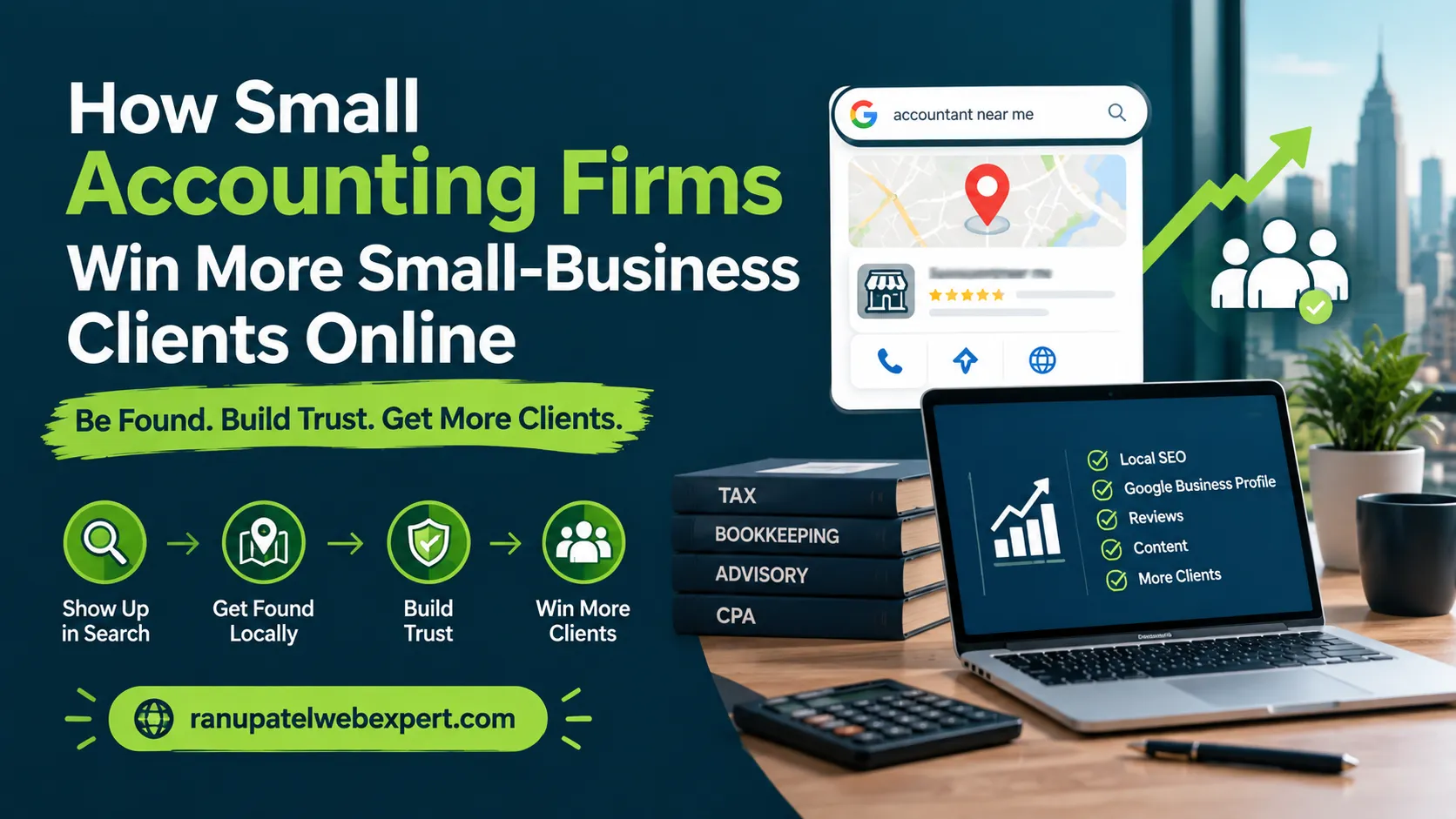
Executive Summary: If you run a small accounting practice—a CPA firm, bookkeeping business, tax-prep service, or solo EA—the hardest part isn’t the accounting; it’s being found by small-business owners at the exact moment they need to hire. While referrals still matter, firms winning the most clients in 2026 show up when owners search online. Winning requires understanding how small businesses evaluate accountants, dominating local search, leveraging niche specializations, and optimizing for AI search.
How Small Accounting Firms Win More Small-Business Clients Online (2026 Guide)
If you run a small accounting practice — a CPA firm, a bookkeeping business, a tax-prep service, or a solo EA — you already know the hard part isn’t the accounting. It’s being found by small-business owners at the exact moment they’re looking to hire. Referrals still matter, but they’re unpredictable, and the firms winning the most small-business clients in 2026 are the ones that show up when owners search online.
Here’s the thing most accounting firms get wrong about their marketing: they talk about themselves. To actually win more clients, you have to start from the other side — understanding how small businesses search for, evaluate, and choose an accountant. Get inside that decision, and everything about how you get found falls into place.
I’m Ranu Patel of RP Web Expert, and I help professional-service firms get found and chosen online. This guide walks through how small businesses choose an accountant in 2026, and exactly how your firm can be the one they pick.
Here’s what we’ll cover: How small businesses actually search for an accountant, why local search decides who gets the call, the niche-specialization advantage, SEO and AI search strategies, and how to execute it trust-first with zero gimmicks.
First: How Small Businesses Choose an Accountant in 2026
You can’t market effectively to small-business clients until you understand how they hire. When a small business needs accounting help — a new company needing bookkeeping, an owner facing tax season, a growing business needing advisory — the path to hiring looks like this:
The 5-Step Client Buying Journey
- 1. The Trigger: Something creates the need (starting up, tax deadline, outgrowing spreadsheets, bad experience with last accountant, or a business milestone).
- 2. The Search: They go to Google and AI tools to search: “small business accountant near me,” “CPA for [industry],” or “bookkeeping services [city].” Even referred prospects look you up online first.
- 3. The Compare: They evaluate who appears in the Google Map pack, top search results, and review ratings to quickly shortlist a few firms.
- 4. The Trust Check: They visit each firm’s website, judging credibility in seconds based on credentials, clear services, professionalism, and industry understanding.
- 5. The Call: They contact the firms that earned their trust — and often go with whoever responds well and fast.
Notice two things: First, this is a high-trust decision — trust and credibility beat price every time. Second, it’s almost entirely online until the call. A firm that’s invisible in search or unconvincing on its website loses clients to firms that are simply easier to find and trust.
Local Search Decides Who Gets the Call
For most small accounting firms, your ideal clients are local. When they search “small business accountant near me” or “CPA in [city],” Google shows the local Map pack first: three firms, with reviews, ready to call. Those three get most of the business.
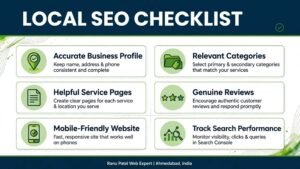
Google Business Profile
Your profile is often the first thing a searching prospect sees. The right category, complete information, services, and consistent NAP details are the foundation for Map pack rankings. Learn about Profile Optimization →
Reviews & Reputation
Because choosing an accountant is a trust decision, genuine client reviews strongly influence both your ranking and whether a prospect picks you. Review growth delivers quick wins in local visibility.
Local SEO & Consistency
City and service pages establish local relevance, while consistent business data across the web builds Google’s authority trust. Explore Local SEO Services →
The Niche Advantage: How Small Firms Beat Big Ones
Here’s the most powerful move available to a small accounting firm, and it’s counterintuitive: don’t try to serve everyone — specialize. You’ll never out-rank national chains like H&R Block on broad terms like “tax preparation.” You beat them on specificity they can’t offer.
Why Specialist Positioning Wins (e.g., “CPA for Real Estate Investors”)
- Far Less Competition: Niche terms are wide open compared to generic “accountant near me.”
- Much Higher Conversion: A prospect who lands on a dedicated niche page feels understood immediately and is far more likely to call.
- Higher Fees: Specialist firms routinely command 30–50% higher fees than generalists because niche expertise carries higher perceived value.
SEO, Content & AI Search Strategy
Do It Professionally — Trust Comes First
For accounting firms, how you market is part of your credibility. Financial services marketing must respect professional standards:
- No Outcome Guarantees: Never promise specific tax savings, refunds, or results; it erodes trust and risks non-compliance.
- Professional & Credible: Reflect the seriousness of financial work—avoid aggressive or gimmicky sales tactics.
- Educational, Not Pushy: Win high-value clients by demonstrating clear expertise, not pressure.
- Accurate & Compliant: Strictly uphold accounting industry ethics and trust-first positioning.
Putting It Together — Your Client-Acquisition System
Be the Firm Small Businesses Find and Trust
At RP Web Expert, I help accounting and professional-service firms get found and chosen online — local SEO, Google Business Profile, website strategy, and AI search visibility — built around trust and real client acquisition.
Frequently Asked Questions
-
How do accounting firms get more small-business clients?
Accounting firms get more small-business clients by being visible when owners search — through local SEO and Google Business Profile for “near me” searches, service and niche pages that rank for specific client needs, educational content that builds trust, and AI search visibility. Since choosing an accountant is a trust decision made largely online, being found and credible at each step is what wins clients.
-
How do small businesses search for an accountant in 2026?
Small businesses search for an accountant mostly online — using Google and increasingly AI tools — with searches like “small business accountant near me,” “CPA for [industry],” or “bookkeeping services [city],” then comparing reviews, checking websites for credibility, and calling the firms they trust. Most start online before asking anyone, and even referred prospects look firms up before contacting them.
-
Why is local SEO important for accounting firms?
Local SEO is important because most small-business clients search locally, and Google shows the Map pack first for “accountant near me” and city searches — those top three firms get most of the calls. It’s also the most underinvested channel relative to its impact for accounting firms, so firms that optimize their Google Business Profile and reviews win disproportionately.
-
Should a small accounting firm specialize in a niche?
Yes — niche specialization is one of the most powerful moves for a small accounting firm, because specialist positioning (like “CPA for real estate investors” or “accounting for e-commerce”) faces far less competition, converts at much higher rates, and commands 30–50% higher fees than generalist firms. It also lets small firms rank nationally for specialist searches, beating larger firms on specificity.
-
How long does SEO take to work for an accounting firm?
Accounting firms with well-executed SEO typically see measurable organic traffic increases in three to four months, with significant ranking improvements for competitive terms in six to nine months, while Google Map pack visibility can improve in four to eight weeks with consistent reviews and profile optimization. It’s a compounding, long-term channel rather than an instant one.
-
Can accounting firms compete with big chains like H&R Block in search?
Yes — but not by competing on their broad head terms. Small accounting firms win by competing on specificity the chains can’t offer: niche client types, local city and neighborhood searches, and specialist services. This lets a small firm dominate targeted searches with far less competition while the chains fight over generic terms.
-
How does AI search affect how clients find accountants?
AI search affects accounting firms because a growing number of small-business owners now ask ChatGPT, Perplexity, and Google’s AI Overviews to find accounting help, and firms cited in those answers capture high-intent discovery traffic. Getting surfaced (Generative Engine Optimization) requires genuine expertise, clear structured information, and credentials — and because it’s a high-trust financial topic, AI favors firms with real authority.
-
When should an accounting firm ramp up its marketing for tax season?
Accounting firms should build their search visibility well before tax season, since demand climbs from January, peaks around April, and spikes again near extension deadlines — and SEO takes months to build. Firms that establish their local and organic visibility in advance capture the seasonal surge, while those starting during the rush are too late to rank in time.
-
Is it worth investing in marketing for a small accounting practice?
Yes — because a single small-business accounting client can have a lifetime value of $12,000 or more, the economics strongly justify investing in client acquisition, and the vast majority of firms are increasing their digital marketing in 2026. Well-executed local SEO and content typically pay back many times over through high-value, long-term clients.
-
Do you help accounting firms with marketing and SEO?
Yes — at RP Web Expert, I help accounting, CPA, bookkeeping, and professional-service firms get found and chosen online through local SEO, Google Business Profile optimization, website strategy, and AI search visibility. The focus is professional, trust-first client acquisition tailored to how small businesses actually choose an accountant, with no gimmicks or guarantees.