A Practical Guide to Avoiding Costly Mistakes and Building for Long-Term Growth
By Ranu Patel | Last Updated: July 2026 | ~8 min read
Executive Summary: Choosing a website designer is an important business decision. Many businesses choose a designer based only on price or visual examples, only to discover later that their website is difficult to update, doesn’t appear in search, or fails to generate enquiries. This guide explains what to look for, the questions worth asking, and the practical factors that support long-term business growth based on 16 years of industry observations.
If you search for website designers in Ahmedabad, you’ll find hundreds of freelancers, agencies, and development companies offering similar promises: Professional websites. Affordable packages. Modern designs. Fast delivery. At first glance, they all seem to offer the same thing.
However, after reviewing business websites for more than 16 years, I’ve found that the difference between a website that simply looks good and one that genuinely supports business growth is rarely the design alone. The most successful websites begin with strategy. They help visitors understand the business, answer common questions, establish trust, and make it easy to take the next step.
Whether you’re launching your first website or replacing an existing one, the decision you make today can influence your marketing, customer experience, and online visibility for years to come. In this guide, I’ll share the practical factors I believe every business owner should consider before hiring a website designer.
Why Choosing the Right Website Designer Matters
A website is no longer just an online brochure. For many businesses, it is the first conversation a customer has with the company. Before calling, emailing, or visiting your office, potential customers usually want answers to basic questions:
- What services do you provide?
- Can I trust this business?
- Have you worked with businesses like mine?
- How do I contact you?
- Why should I choose you instead of another company?
A well-planned website answers these questions naturally, whereas a poorly planned website leaves visitors uncertain—even if the design looks modern. Choosing the right web professional means choosing someone who understands how people make decisions, not simply how software works.
The Biggest Mistake Businesses Make
The most common mistake isn’t hiring an inexperienced designer; it’s hiring based only on price. A lower quote may appear attractive initially, but many businesses later discover hidden costs such as redesigns, missing functionality, limited flexibility, or websites that are difficult to update.
Another common issue is selecting a designer who focuses exclusively on appearance without understanding business goals. An attractive homepage cannot compensate for unclear messaging, poor navigation, or a website that fails to guide visitors toward making an enquiry.
“Instead of asking, ‘Who offers the cheapest website?’, consider asking, ‘Who understands my business and can build a website that supports it over the next five years?’ That question often leads to a very different decision.”
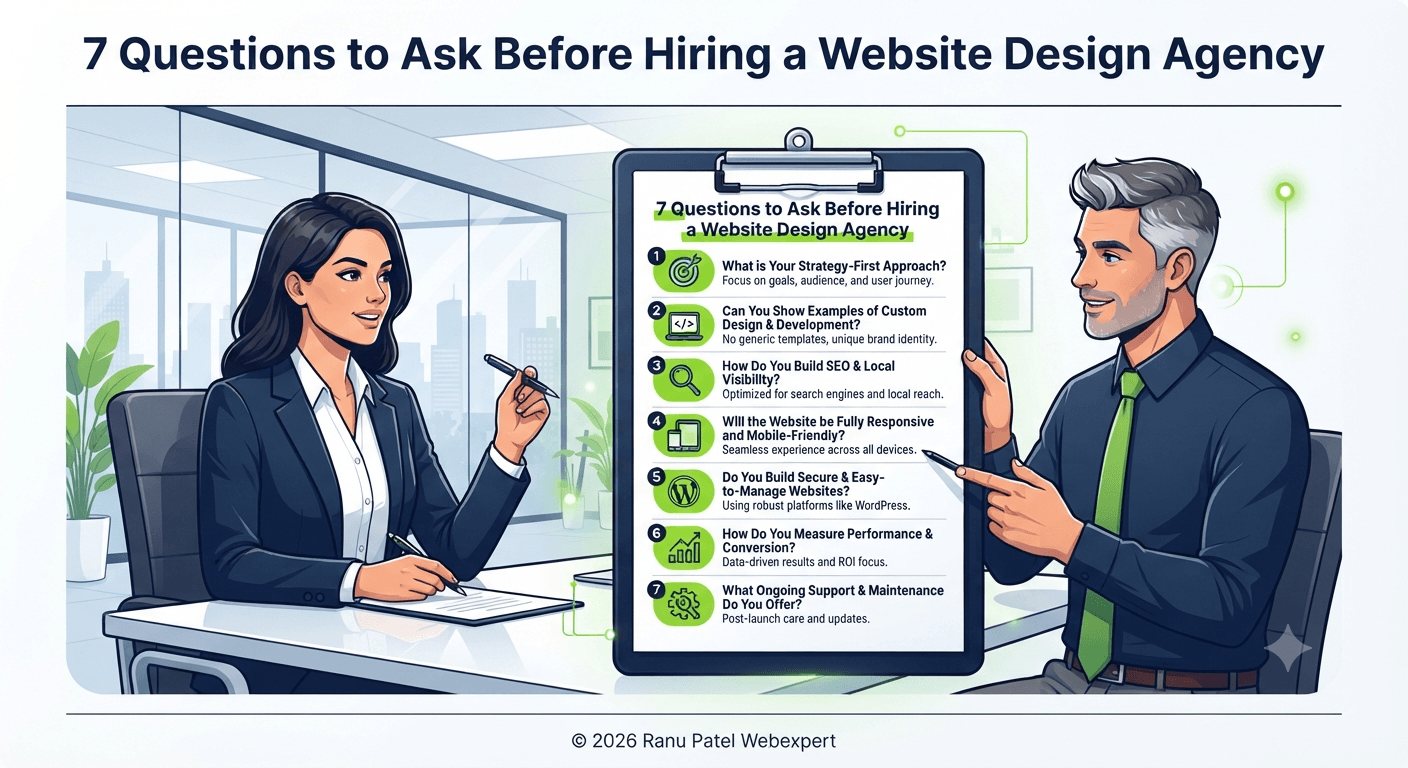
7 Questions to Ask Before Hiring a Website Designer
Before entering a partnership, ensure you run through these foundational operational questions with your prospective vendor:
- How Will You Understand My Business Before Designing? — A website should be built around your customers, services, and business goals—not a template. It requires a strategy-first approach to mapping out your entry channels and competitor landscape.
- Who Will Own My Website? — This is often overlooked. Ensure you retain 100% full ownership of your domain name, web hosting setup, business email accounts, About Ranu Patel credentials, Google Analytics, and Google Search Console.
- Can I Update the Website Myself? — A modern business shouldn’t need a developer for small updates. Utilizing an easily accessible platform like WordPress provides exceptional flexibility for managing team profiles, blogs, and core details when planned properly.
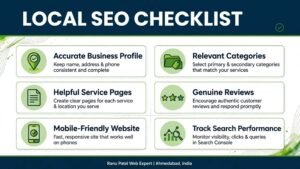
- Will My Website Support Local SEO? — Many businesses assume SEO can simply be added later. While ongoing search visibility is a standalone discipline, your site must feature technical foundations—like mobile responsiveness, clean code, optimized speed, and logical navigation—from day one. Explore structured foundational integrations like Local SEO Services.
- What Happens After Launch? — Handing over files isn’t the finish line. Inquire clearly about routine maintenance cycles, system updates, server security layers, cloud backups, and clear paths for future technical improvements.
- Have You Worked With Businesses Similar to Mine? — Cross-industry layout mechanics vary drastically. For instance, a complex manufacturer’s catalogue flow shouldn’t track like a local dental clinic, just as a visual architect’s showcase requires different architectures than an accounting firm.
- How Will We Measure Success? — Shift parameters away from vague layout benchmarks. Focus instead on structural indicators: Do target users find answers quickly? Are paths optimized to help them contact you easily?
What Makes a Good Business Website?
After auditing commercial networks across multiple industries over the years, the most effective digital ecosystems consistently share several foundational characteristics:
- They Explain Services Clearly: Visitors shouldn’t have to guess. Each core business vertical deserves an isolated, explicit service asset breaking down who it serves, step-by-step engagement processes, explicit benefits, and tailored FAQs.
- They Build Trust Naturally: Genuine customer alignment emerges through transparent corporate layouts—clean founder insight profiles, authentic project case studies, context-rich client testimonials, and verified contact points.
- They Are Easy to Navigate: Simple navigation structures routinely outperform over-engineered multi-tier menu hierarchies. Your visitors want fast, friction-free answers to precise commercial problems.
- They Work Well on Mobile: Because a massive chunk of localized transactional searches initiate via smartphone screen form factors, responsive asset engineering directly safeguards overall conversions.
- They Continue Improving: Highly profitable digital assets are rarely completely finished static pieces. As consumer expectations shift and your business naturally scales up, workflows demand agile post-launch structural iteration.
Freelancer, Agency, or Website Consultant: Which Is Right for You?
The right operational model depends directly on the complexity of your scale targets, immediate asset criteria, and the precise depth of strategic management alignment you want:
| Option | Best For | Considerations |
|---|---|---|
| Freelancer | Small projects, quick test pilots, and early-stage startups. | Usually more budget-friendly, but specialized skill depth and long-term day-to-day availability can vary wildly. |
| Agency | Larger corporate entities with multiple internal stakeholders. | Offers access to broad multidisciplinary teams, but carries higher structural overhead costs and less direct personal alignment. |
| Independent Website Strategist | Businesses seeking a highly collaborative, strategy-first growth partner. | Direct access to the exact expert architect mapping and building the asset, with choices calibrated entirely to business performance goals. |
Practical Observations From 16+ Years of Website Reviews
After reviewing countless corporate digital platforms over the last 16+ years, these consistent industry observations stand out:
- Observation 1: Many businesses waste excessive space detailing internally focused corporate history rather than giving crystal-clear breakdowns of their transactional customer services.
- Observation 2: Target prospects never convert because an interface has flashy interactive animations. They reach out because they clearly understand what is offered, why it applies to them, and how to execute the next step.
- Observation 3: High-performing web ecosystems solve real user questions before the visitor ever thinks to ask them. A strategically mapped out FAQ architecture elevates prospective client confidence far better than layout marketing copy.
- Observation 4: Small, consistent technical iterations over an extended timeline yield massive compound long-term ROI over waiting several passive years for a disruptive, expensive top-to-bottom redesign. For more info, explore our upcoming guides on the Website Redes Checklist and a deep-dive analysis on WordPress vs Website Builders.
Common Mistakes to Avoid
Keep a sharp eye out for these critical, conversion-killing web design planning pitfalls:
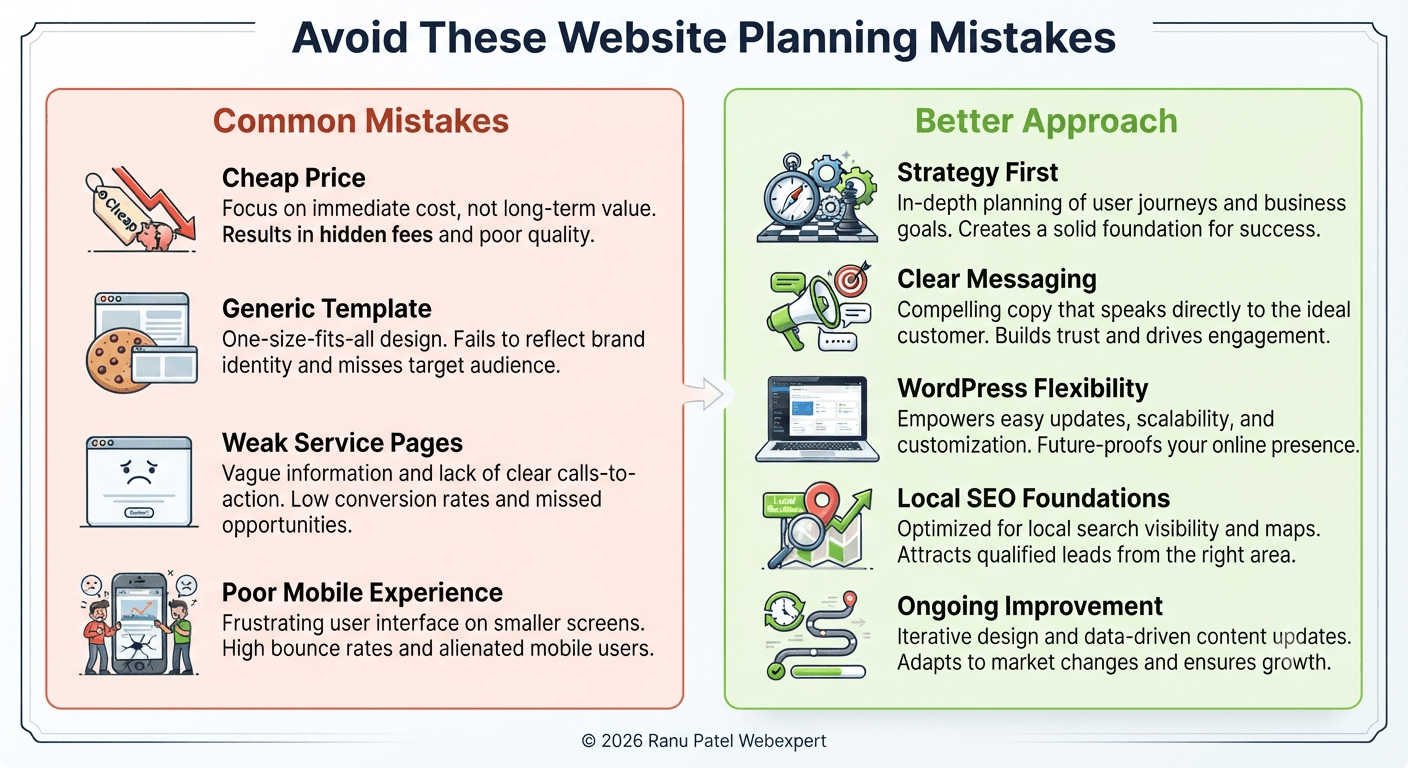
- Choosing vendors based strictly on cheapest price
- Blindly copying surface-level competitor layouts
- Prioritizing abstract design over copy clarity
- Overlooking mobile usability friction points
- Deploying systems missing local organic SEO setups
- Plastering generic, uninspiring stock images
- Failing to design for modular scalability
- Leaving out a structured ongoing maintenance budget
- Building superficial, text-light service pages
- Missing clean internal linking architectures
Final Thoughts: A Practical Checklist
Hiring the right specialist is about sourcing a partner who appreciates consumer psychology, structural mapping, and digital communication mechanics. Before signing your development proposal or finalizing budgets for local initiatives like a Web Design Ahmedabad project, run down this quick qualification check:
- ✓ Does this specialist clearly demonstrate a deep structural understanding of my industry vertical?
- ✓ Will my internal business entity fully retain explicit legal ownership of all core tracking domain assets?
- ✓ Can our execution team fluidly scale text elements, drop content modifications, or make edits without assistance?
- ✓ Is an open content management framework like WordPress being properly configured to fulfill our long-term objectives?
- ✓ Are core optimization layers and local geographic index signals meticulously coded directly into the baseline layout?
- ✓ Is there a comprehensive structural roadmap protecting our operations against security bugs and code depreciation after deployment?
Frequently Asked Questions
- 1. How do I choose the right website designer in Ahmedabad?
Look beyond portfolios and pricing. Choose someone who takes time to understand your business, explains their process clearly, builds on a platform you own, and considers long-term growth rather than only visual design. - 2. Should I hire a freelancer or a web design company?
Both can be suitable depending on your project. The important factor is whether the person or team understands your business goals, communicates clearly, and can support your website after launch. - 3. Is WordPress a good choice for a business website?
For many businesses, yes. WordPress offers flexibility, ownership, and the ability to expand your website over time. It also supports content publishing, integrations, and long-term improvements. - 4. How much does a business website cost in Ahmedabad?
Costs vary depending on the scope, functionality, content, and integrations required. Rather than comparing prices alone, compare the planning process, long-term value, and support included. See our upcoming analysis on Business Website Cost in Ahmedabad. - 5. Does website design include SEO?
A professionally planned website should include technical SEO foundations such as clear page structure, responsive design, metadata support, and logical navigation. Ongoing SEO and content marketing continue after the website is launched. - 6. Why is Local SEO important for business websites?
If your business serves customers in specific locations, Local SEO helps search engines understand where you operate and improves the chances of appearing in relevant local searches. - 7. Can I update my WordPress website myself?
Yes. A properly developed WordPress website should allow you to edit pages, publish blogs, update images, and make routine changes without relying on a developer. - 8. How long does it take to build a business website?
A typical business website takes 3–8 weeks, depending on project complexity, content readiness, revisions, and additional functionality. - 9. What should a business website include?
Most business websites should include clear service pages, an About page, contact information, testimonials, FAQs, a blog or resources section, and calls-to-action that guide visitors toward making contact. - 10. Can you redesign an existing website instead of creating a new one?
Yes. In many cases, improving the structure, messaging, navigation, and technical foundations of an existing website can deliver better results than rebuilding it from scratch. - 11. Will a new website help my business rank higher on Google?
A well-planned website provides a stronger foundation for search visibility, but rankings also depend on factors such as content quality, Local SEO, Google Business Profile optimisation, backlinks, competition, and ongoing improvements. No website alone can guarantee rankings. - 12. How often should a business website be updated?
Review your website regularly. Update services, contact information, content, and technical components as your business evolves. Continuous improvements generally provide better long-term results than infrequent redesigns.
Planning a New Website?
Whether you’re starting your first website, redesigning an existing one, or simply looking for an independent review, I’m happy to help you make informed decisions. Let’s start by understanding your business, customers, and long-term goals.
About the Author
Ranu Patel is a Founder, Website Strategist, and Local SEO Consultant with over 16 years of corporate expertise delivering engineering solutions across Ahmedabad, Gujarat, and global ecosystems. Drawing from clear operational architecture blueprints, Ranu empowers business owners to construct high-performing, agile digital presences that convert search audiences into lasting business equity.
Editorial Note: This guide is reviewed periodically to reflect shifting trends in business website engineering strategy, modern WordPress development best practices, foundational Local SEO configurations, and evolving AI-powered search optimization requirements.